_edited.png)
Ancient Cryptography: The Dawn of Secret Codes

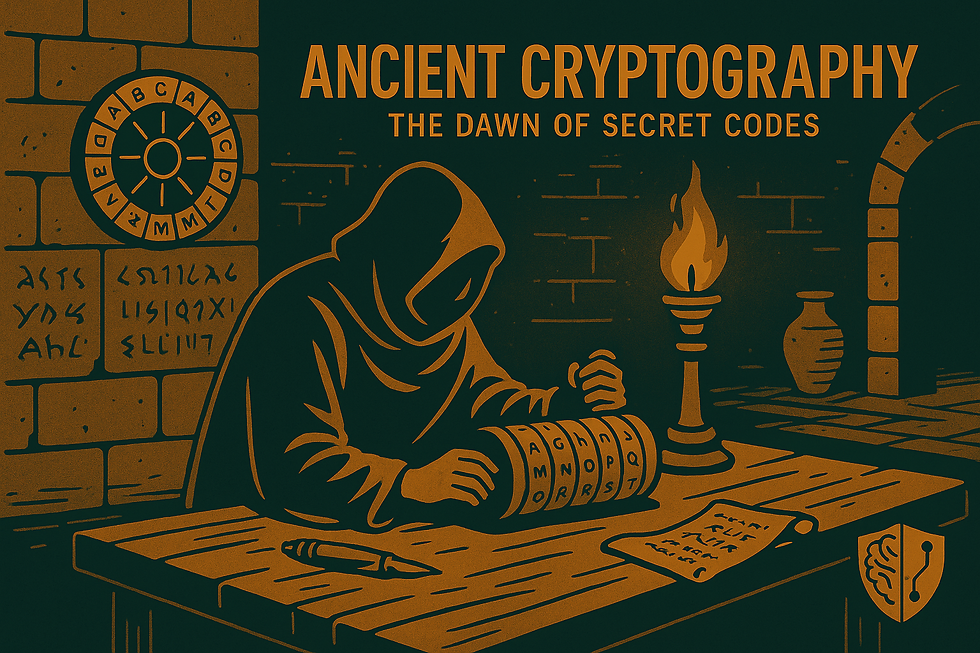
Imagine a world lit by torchlight, where messages were whispered in darkened rooms, carried by trusted messengers through shadowed alleyways, and hidden from enemy eyes under layers of secrecy. In a time long before digital encryption or the hum of machines, ancient civilizations, from pharaohs in Egypt to generals in Sparta, were already weaving a language of secrecy—a world where codes, symbols, and hidden messages held the power of life, death, and victory. This is the story of cryptography’s dawn, a journey through ancient scrolls, mysterious glyphs, and the primal human need to conceal what matters most.
The Origins of Cryptography
The word "cryptography" comes from the Greek words kryptos (hidden) and graphien (writing), and the first cryptographic practices date back over 4,000 years. Ancient leaders, military generals, and royalty understood the importance of secure communication, especially during wars or political intrigue. While today’s cryptographic systems rely on complex mathematical algorithms, ancient cryptography was all about ingenuity, stealth, and simplicity.
In fact, early forms of cryptography also appear in the ancient Indian epics, such as the Mahabharata, which describes covert messages delivered to shield critical strategies from enemies during the great war. This idea of "hidden messaging" aligns with cryptographic principles of concealing and protecting information—a concept also touched upon in the Bhagavad Gita as gupta vidya, or "hidden knowledge." Here, information is treated as sacred and accessible only to those prepared to understand it, a notion that connects philosophically to the concept of encryption itself.
The Egyptian “Hieroglyphics of Mystery”
The Egyptians were among the first civilizations to adopt cryptographic techniques. Hieroglyphics, their well-known script, sometimes included additional symbols or substitutions to obscure meanings, likely intended for religious or ceremonial purposes. These early attempts at encryption weren’t meant to secure state secrets, but they did introduce the idea that written language could carry hidden meanings.
The most famous Egyptian cryptographic text is found in the tomb of Khnumhotep II, dating back to around 1900 BCE. In it, scribes used unusual symbols and arrangements to mask certain parts of the text. Although this wasn’t "encryption" as we think of it today, it was a clear attempt to conceal information from the average reader.
The Spartans and the Scytale: A Military Cipher
In the world of ancient warfare, the Spartans were pioneers of military cryptography. Around the 5th century BCE, they developed a tool called the scytale—a simple yet effective cipher device. The scytale consisted of a cylindrical stick and a strip of parchment. Here’s how it worked:
A strip of parchment was wound around the cylinder.
The sender wrote the message along the length of the cylinder.
When the strip was unwrapped, the letters appeared scrambled and illegible.
To decipher the message, the recipient would need a scytale of the exact same diameter. By wrapping the parchment around their own cylinder, the scrambled letters would align correctly, revealing the original message. This method wasn’t particularly secure by today’s standards, but it was a clever way to keep enemy forces guessing.
Caesar’s Cipher: Julius Caesar’s Secret Messages
Perhaps the most famous cryptographic technique from the ancient world is Caesar’s Cipher. Named after Julius Caesar, this method involved shifting each letter of the alphabet by a fixed number of places. For example, if Caesar used a shift of three, the letter "A" would become "D," "B" would become "E," and so on. The message would appear as gibberish to anyone who didn’t know the shift value.
Here’s an example of how Caesar’s Cipher worked with a shift of three:
Original Message: ATTACK AT DAWN
Encrypted Message: DWWDFN DW GDZQ
Caesar used this technique to communicate with his generals securely. Even though it’s easy to break by today’s standards, it was an effective method for its time, as only someone familiar with the shift could decode the message.
I first encountered Caesar’s Cipher during INSE 6110, Introduction to Cryptography, one of the foundational courses I took at Concordia University with Prof. Ayda Basyouni. It was here, amidst the study of old symmetric ciphers, that I learned how early methods like Caesar’s Cipher, a classic shift cipher, laid the groundwork for modern encryption. Symmetric ciphers rely on the same key for both encryption and decryption, a concept rooted in simplicity and efficiency, much like Caesar’s method. With each shift in the alphabet, Caesar’s Cipher transformed ordinary text into a protected message that only those “in the know” could read, underscoring the strategic and creative depths that make cryptography more than just code.
Steganography: Hiding Messages in Plain Sight
In addition to encryption, ancient civilizations used steganography, the practice of concealing a message within another medium. Unlike encryption, which scrambles a message, steganography hides the very existence of the message.
One of the earliest examples comes from ancient Greece. Histiaeus, an exiled Greek ruler, wanted to incite a rebellion against the Persian king. To send a secret message, he shaved the head of one of his slaves and tattooed a message on the scalp. After the slave’s hair grew back, he was sent to the intended recipient. When the message was needed, the recipient shaved the slave’s head again to reveal the tattooed instructions.
In another example, Demaratus, a Greek who needed to warn Sparta about a Persian invasion, used wax tablets. He wrote the warning on the wood, covered it with a fresh layer of wax, and then sent it off. To the casual observer, it looked like an unused tablet, but Spartan officials knew to melt the wax and reveal the hidden message.
The Atbash Cipher: A Hebrew Encryption Technique
The Atbash cipher was a substitution cipher originally used in the Hebrew language. It works by reversing the alphabet, where the first letter becomes the last, the second letter becomes the second to last, and so on. Here’s an example with the English alphabet:
Original Alphabet: ABCDEFGHIJKLMNOPQRSTUVWXYZ
Atbash Alphabet: ZYXWVUTSRQPONMLKJIHGFEDCBA
Using this substitution, the word “HELLO” would be encrypted as “SVOOL.”
Atbash is one of the earliest examples of a monoalphabetic cipher, where each letter in the plaintext is replaced with the same letter in the ciphertext every time it appears. While simple, the Atbash cipher introduced the concept of systematic substitution, a foundational idea in cryptography.
The Legacy of Ancient Cryptography: Foundations of Modern Security
The cryptographic techniques developed by ancient civilizations may seem rudimentary by today’s standards, but they left an indelible mark on the field of secure communication. These early methods laid the groundwork for the complex algorithms and protocols that safeguard modern digital information. The principles pioneered thousands of years ago—concealment, substitution, and layered security—still resonate deeply within today’s cybersecurity practices.
From Physical to Digital Security
The scytale, Caesar’s Cipher, and steganographic methods like hidden tattoos and wax-covered tablets demonstrated that securing information is as much about human ingenuity as it is about tools and techniques. These early methods introduced concepts like key-based security (as with the scytale’s required cylinder size) and substitution ciphers (as seen in Caesar’s shift cipher and Atbash). Today, these foundational ideas are mirrored in modern encryption systems, where digital keys and layered security protocols protect sensitive data from unauthorized access.
Inspiring Modern Cryptography
Ancient cryptography provides a historical lens through which we can view our current security needs. In particular:
Caesar’s Cipher inspired the development of more sophisticated substitution ciphers, which evolved into the complex algorithms that protect data in transit today.
Steganography remains relevant, especially with the rise of digital media, where messages can be hidden in images, audio files, and other formats. Today, it’s a common technique for securing sensitive communications in hostile environments and preventing data from being flagged by automated monitoring systems.
A Timeless Lesson: The Human Factor in Security
One of the most profound legacies of ancient cryptography is the emphasis on the human element. Whether it was the curiosity sparked by an unassuming wax tablet or the secrecy of a tattooed message, ancient methods taught us that security often hinges on understanding human behavior. This focus on psychology and human factors is central to modern cybersecurity, where social engineering attacks, phishing schemes, and manipulation remain some of the most effective methods for breaching security.
Continuing the Tradition of Innovation
Ancient cryptography’s legacy also lies in its spirit of creativity and adaptability. The ancient Spartans and Romans were quick to adapt their methods to meet the needs of their environments, and this adaptability has shaped modern cryptographic theory. In cybersecurity, where threats evolve daily, the need to innovate continuously and adapt defenses is crucial. Today’s cryptographic landscape—ranging from symmetric and asymmetric encryption to emerging quantum-resistant algorithms—stands as a testament to the creative legacy that began with rudimentary scytales, simple shift ciphers, and hidden messages.
A Lasting Impact on Cybersecurity and Privacy
The evolution from ancient ciphers to today’s digital encryption reflects humanity’s enduring desire for privacy and secure communication. Ancient cryptography underscores a fundamental truth that remains unchanged: as long as information holds power, the need to protect it will drive innovation. The legacy of these early methods reminds us that, although the tools have changed, the core values of confidentiality, creativity, and vigilance endure.
Why Ancient Cryptography Still Matters
The cryptographic techniques of ancient times may seem primitive today, but they laid the groundwork for the sophisticated methods we use now. The scytale introduced the idea of a cipher device; Caesar’s Cipher demonstrated the concept of shifting characters, and steganography showed that hiding a message could be as effective as encrypting it.
In today’s world, encryption is essential for protecting everything from personal messages to financial transactions. But the same principles of secrecy, creativity, and strategic thinking have carried through the ages. Ancient cryptography is a reminder of humanity’s timeless need for privacy and security, a need that continues to drive innovation in cybersecurity today.
Lessons for Cybersecurity Professionals
The cryptographic practices of ancient times may seem distant, but the principles behind them remain surprisingly relevant. Here are a few timeless lessons from these early techniques that continue to shape modern cybersecurity:
Adapt and Innovate: The Spartans and Greeks utilized physical objects and unconventional methods like the scytale and hidden tattoos to protect vital messages. This ingenuity reminds us that security is about creativity and adaptability—skills that are just as critical for today’s security experts navigating complex digital landscapes.
Simplicity is Strength: Many ancient methods were effective precisely because they were straightforward yet clever. In modern cybersecurity, simplicity often reduces vulnerabilities. Sometimes, the best solutions are those that minimize complexity, focusing on robustness over intricacy.
Layered Security: Ancient civilizations didn’t rely on a single technique. They combined methods, like encryption and steganography, to maximize message security. This approach echoes today’s “defense-in-depth” strategy, where multiple layers of security create a stronger, more resilient defense.
Cryptography’s journey from simple shifts and hidden symbols to today’s advanced algorithms underscores a timeless truth: the need for privacy, security, and creative problem-solving is as old as humanity itself. As we look toward future innovations like quantum encryption and AI-driven security, it’s fascinating to remember that it all started with a scytale, a hidden tattoo, and the human desire to keep secrets safe.


Comments